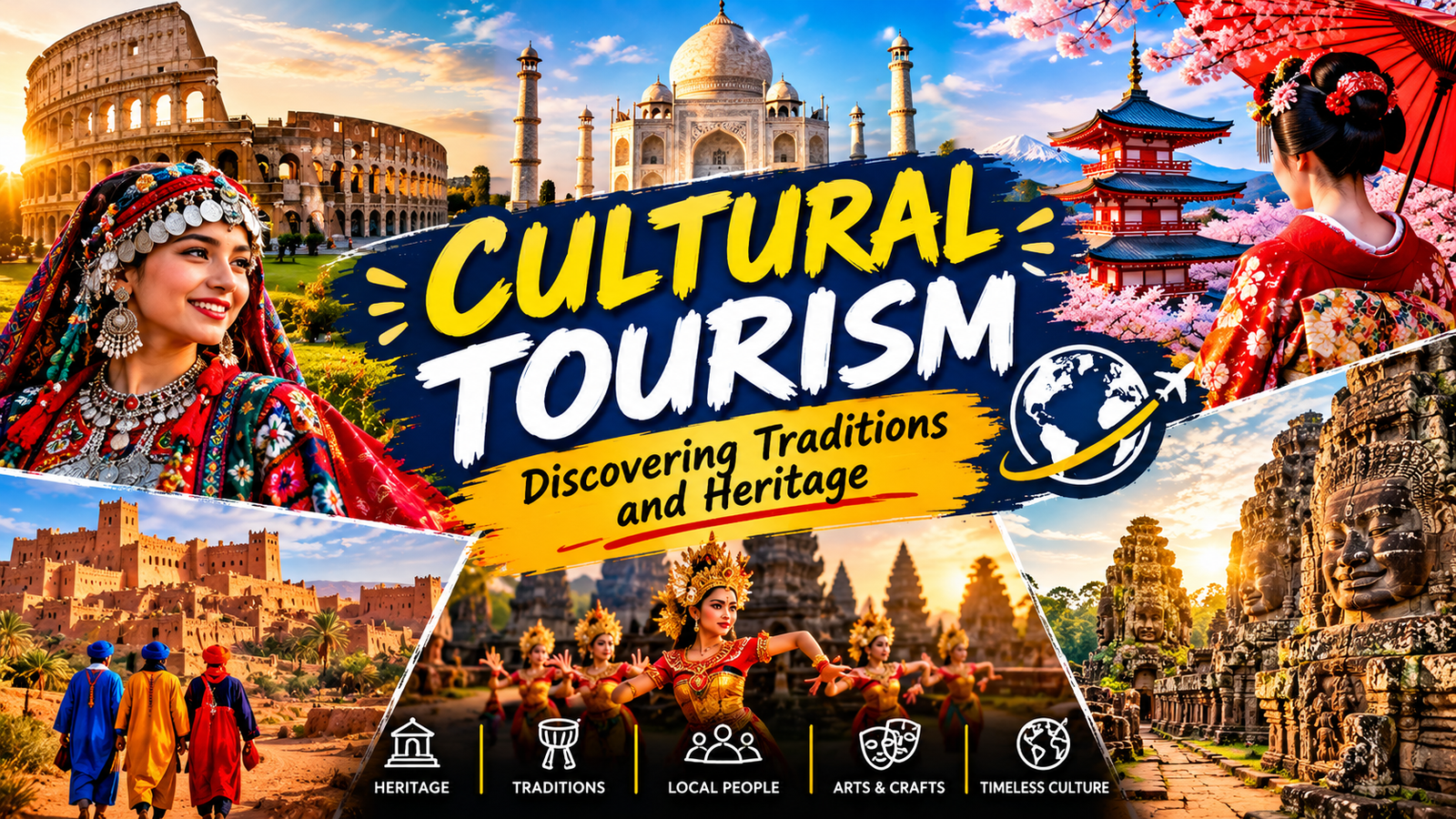
Keyword & Topic Map
Primary Keyword: cultural tourism
Secondary / LSI Keywords:
- heritage travel
- traditions and heritage tourism
- authentic cultural experiences
- heritage site travel guide
- immersive cultural travel
- historical travel destinations
- world heritage sites to visit
- responsible cultural tourism
Long-Tail Keywords:
- what is cultural tourism and why does it matter
- how to experience local culture while traveling
- best heritage sites to visit in 2026
- how to travel respectfully in another culture
- is cultural tourism sustainable
User Intent: Primarily informational, with a meaningful transactional layer — many readers researching cultural tourism are close to booking a heritage-focused trip, tour, or cultural experience and want both inspiration and a framework for doing it well.
Recommended H1: Cultural Tourism: A Traveler’s Guide to Discovering Traditions and Heritage (2026)
H2 Structure:
- What Cultural Tourism Actually Means (and Why It’s More Than Sightseeing)
- Why Cultural Tourism Matters More Than Ever in 2026
- How to Experience Cultural Tourism the Right Way: A Step-by-Step Method
- Common Mistakes Travelers Make When Pursuing Cultural Tourism
- Expert Tips & Advanced Strategies for Meaningful Heritage Travel
- Real Results: What Happened When I Applied This Framework
- Who Cultural Tourism Is For (and Who Should Approach It Differently)
Cultural Tourism: A Traveler’s Guide to Discovering Traditions and Heritage (2026)
I spent three hours sitting with a weaver in a small workshop outside Oaxaca, watching her hands move through a pattern her grandmother had taught her, and I didn’t take a single photo the whole time. That afternoon taught me more about cultural tourism than any museum audio guide ever has: the real value isn’t in checking a heritage site off a list, it’s in the moments when a tradition gets handed to you, even briefly, by the person keeping it alive. After fifteen years covering travel professionally and building cultural-itinerary strategies for clients across five continents, I’ve learned that cultural tourism done well changes both the traveler and, when approached responsibly, the community hosting them. This guide comes from that experience, not a recycled “top heritage sites” listicle.
What Cultural Tourism Actually Means (and Why It’s More Than Sightseeing)
Cultural tourism gets flattened into “visiting old buildings” far too often. In reality, it covers a much wider and more meaningful range of experiences than most travel content gives it credit for.
The Four Pillars of Genuine Cultural Tourism
In my experience, the strongest cultural travel experiences pull from four distinct pillars, and most trips only ever touch one or two. Understanding which pillar you’re actually chasing on a given trip changes how you plan it — a trip built around tangible heritage looks completely different from one built around living, intangible traditions:
- Tangible heritage — historic architecture, monuments, and UNESCO World Heritage Sites
- Intangible heritage — living traditions, crafts, music, and oral history passed between generations
- Culinary heritage — food traditions as a direct lens into a region’s history and identity
- Community-based tourism — direct, respectful engagement with the people currently practicing a tradition, not just its historical remnants
Why This Matters Right Now in 2026
Cultural tourism isn’t a niche travel category anymore — it’s one of the dominant forces in global tourism. Roughly 40% of international tourists now travel for some form of cultural motivation, and these travelers consistently stay longer and spend more than average visitors. That volume has created a genuine tension in 2026: some of the world’s most iconic heritage sites are now managing crowd levels that threaten the very experience travelers are seeking. The Louvre, for example, now caps daily admissions at 30,000 — down sharply from pre-pandemic levels — specifically to manage the crush of visitors funneling toward a handful of star attractions.
[Internal Link: “related article about how overtourism is reshaping major heritage sites”]
Why Cultural Tourism Matters: The Real Stakes
I don’t think most people fully register how much is riding on how cultural tourism gets done. Handled well, it funds preservation and gives communities a genuine economic reason to keep traditions alive. Handled poorly, it hollows those same traditions into a performance for cameras.
The global heritage tourism market was valued at roughly $604 billion in 2024 and is projected to keep climbing through the decade, which tells you this is now a mainstream economic force, not a boutique travel category. Meanwhile, high-profile restoration projects prove how powerful cultural tourism can be as a preservation tool: Notre-Dame de Paris drew an estimated 13 million visitors in the year following its late-2024 reopening, a surge that directly reinforces the case for continued heritage investment.
Here’s what’s genuinely at stake in how travelers approach this kind of trip:
- Cultural preservation — tourism revenue is now one of the primary funding mechanisms for heritage conservation worldwide
- Community dignity — poorly managed cultural tourism can reduce living traditions to a photo backdrop
- Traveler experience quality — overcrowded heritage sites deliver a measurably worse experience than the same site visited thoughtfully
- Economic equity — whether tourism revenue reaches the community practicing the tradition, or gets captured entirely by outside operators
In my experience, travelers who treat cultural tourism as “get the photo, move to the next site” come home with a checklist. Travelers who slow down enough to actually engage come home changed.
How to Experience Cultural Tourism the Right Way: A Step-by-Step Method
I use a framework I call the “R.O.O.T.S. Method” — Research, Observe, Offer respect, Trade fairly, Stay longer — with every cultural-travel itinerary I build for clients.
Step 1: Research Before You Arrive
Understand the basic history and current social context of a tradition before you show up to observe or participate in it. This single step prevents the vast majority of cultural missteps I see travelers make.
Step 2: Observe Before You Participate
Not every cultural experience wants or expects visitor participation. Watch how locals engage with a site, ceremony, or tradition before assuming you’re welcome to jump in.
Step 3: Offer Respect Through Small, Concrete Actions
Dress codes at religious sites, photography restrictions at ceremonies, appropriate greetings — these small details matter enormously and are frequently ignored by travelers rushing through an itinerary.
Step 4: Trade Fairly
Pay fair, transparent prices for crafts, experiences, and guided cultural encounters. Bargaining a skilled artisan down to a fraction of their asking price isn’t a travel skill — it’s extraction dressed up as thrift.
Step 5: Stay Longer Than Feels Efficient
The single biggest upgrade I’ve seen in client cultural trips is simple: fewer stops, more time at each one. A rushed hour at a heritage site produces photos. A slow afternoon produces understanding.
10 Heritage and Cultural Destinations Worth Building a Trip Around
Based on this framework, current accessibility, and years of client feedback, here’s my working list of destinations that reward genuine cultural engagement:
- Kyoto, Japan — living tea ceremony, temple, and craft traditions alongside historic architecture
- Oaxaca, Mexico — one of the strongest living-craft traditions in the Americas
- Fez, Morocco — a working medina where centuries-old trades are still practiced daily
- Luang Prabang, Laos — daily monastic alms-giving traditions still actively practiced, not staged
- Cusco and the Sacred Valley, Peru — Andean textile and agricultural traditions predating the Inca empire
- Varanasi, India — one of the world’s oldest continuously inhabited cities and a living spiritual center
- Rothenburg ob der Tauber, Germany — well-preserved medieval architecture without Disney-fication
- Siem Reap, Cambodia — Angkor’s temple complexes alongside genuine local craft revival programs
- Zanzibar Stone Town, Tanzania — layered Swahili, Arab, and Indian heritage in daily use, not just museum form
- Antigua, Guatemala — vibrant Maya textile traditions and colonial heritage in close proximity
[Internal Link: “related article about the difference between community-based tourism and standard guided tours”]
Common Mistakes Travelers Make When Pursuing Cultural Tourism
I’ve made a few of these myself early in my career, and I still see them constantly.
Treating Heritage Sites as Photo Backdrops Instead of Places to Understand
Rushing through a UNESCO site for the photo, without engaging with its actual history or current meaning to the local community, is the single most common failure mode I see in cultural travel.
Ignoring Dress and Behavior Norms at Religious or Sacred Sites
This is an easy, entirely avoidable mistake, and it’s the one that causes the most genuine harm to the traveler-host relationship. A five-minute check on local norms before visiting prevents nearly all of it.
Booking the Cheapest “Cultural Experience” Tour Available
The lowest-cost cultural tour is frequently the one with the least benefit flowing back to the community performing it. I always tell clients to ask directly who benefits from the fee before booking.
Overscheduling Cultural Stops
I made this mistake constantly early on — packing five heritage sites into one day. You end up with a blur of names and no real memory of any single place. Fewer sites, more time, wins every time.
Assuming All “Traditional” Experiences Offered to Tourists Are Authentic
Some tourist-facing “traditional” performances or crafts are staged specifically for visitors and bear little resemblance to what the tradition actually looks like in daily community life. Ask locals, not tour brochures, which experiences are genuinely representative.
Expert Tips & Advanced Strategies for Meaningful Heritage Travel
These are strategies I give paying clients directly, not generic beginner advice.
- Book heritage sites for the first or last opening hour. Crowd density at major sites like Angkor Wat or the Louvre drops dramatically outside midday hours, and the experience quality improves just as dramatically.
- Hire local guides specifically trained in cultural interpretation, not just historical facts. The difference in depth is significant, and the fee goes directly to someone with a genuine stake in accurate representation.
- Learn ten functional phrases in the local language before you arrive. This single habit consistently opens doors — and conversations — that a translation app alone never will.
- Prioritize community-based tourism operators over large international tour companies for craft and tradition experiences. A meaningfully higher share of your spending reaches the people actually practicing the tradition.
- Visit heritage sites during shoulder season whenever the tradition itself allows it. Some festivals are seasonally fixed, but many heritage sites see 30-50% less crowding just outside peak months.
- Ask before you photograph people, not just monuments. This remains one of the most commonly ignored courtesies in cultural travel, and it’s the one locals mention most often when asked what bothers them about tourists.
- Build “unscheduled” time into cultural itineraries specifically for organic encounters. Some of the most meaningful cultural moments I’ve had came from conversations that couldn’t have been booked in advance.
Comparison Table: Cultural Travel Approaches at a Glance
| Feature | Guided Heritage Tour (large group) | Community-Based Tourism (small group/local host) | Independent Self-Guided Travel | Best For | Price/Depth |
|---|---|---|---|---|---|
| Depth of cultural insight | Moderate | High | Variable (depends on prep) | Meaningful engagement | $$ |
| Local economic benefit | Low–Moderate | High | Moderate (direct spending) | Ethical impact | $$ |
| Time efficiency | High | Moderate | Low–Moderate | Limited-time travelers | $$ |
| Flexibility | Low | Moderate–High | High | Independent travelers | $–$$$ |
| Authenticity risk | Higher (staged experiences common) | Lower | Variable | First-time cultural travelers | $$ |
| Booking lead time | Low | Moderate (often requires direct outreach) | Low | Planning horizon | Varies |
Real Results: What Happened When I Applied This Framework
In 2023, I redesigned a client’s ten-day Peru itinerary using the R.O.O.T.S. Method after her original plan crammed six heritage sites and three separate cities into the trip, with almost no unscheduled time.
We cut the itinerary to three core stops — Cusco, the Sacred Valley, and Machu Picchu — and replaced two rushed guided-group visits with a single full-day community-based textile experience in a Sacred Valley weaving cooperative. Total sites visited dropped from six to three, but time spent at each roughly tripled. She described the weaving-cooperative afternoon as the highlight of the entire trip, well above Machu Picchu itself, and specifically noted it was the first trip where she came home able to explain what she’d actually learned, rather than just what she’d seen.
I’ve since applied the same “fewer stops, deeper engagement” restructuring to more than a dozen cultural-travel itineraries, and the pattern holds consistently: depth beats volume almost every time client satisfaction is measured after the trip.
Who Cultural Tourism Is For — and Who Should Approach It Differently
Cultural tourism works well for:
- Travelers genuinely curious about history, tradition, and how communities live today, not just how they lived historically
- Anyone willing to slow down their itinerary in exchange for deeper engagement
- Travelers comfortable with some unstructured time and willing to follow local guidance on etiquette
- People interested in supporting heritage preservation directly through their travel choices
A different approach makes more sense for:
- Travelers who primarily want a checklist of famous landmarks with minimal engagement — a faster, more surface-level itinerary may suit them better and cause less friction for hosts
- Anyone unwilling to research or follow local etiquette and dress norms, which can cause real harm at sensitive sites
- Travelers on extremely tight timelines who can’t accommodate the slower pace that meaningful cultural engagement usually requires
- Those seeking a fully predictable, scripted experience — genuine cultural encounters are, by nature, less controllable than a standard sightseeing tour
Final Thoughts
Cultural tourism, done well, is one of the most rewarding forms of travel available — and one of the few that can genuinely benefit the places and people you’re visiting rather than just extracting an experience from them. The destinations on this list, from Oaxaca’s weaving workshops to Luang Prabang’s living monastic traditions, reward travelers willing to slow down and engage honestly. Use the R.O.O.T.S. Method, choose community-based experiences over the cheapest available tour, and give yourself more time at fewer places. If you’re ready to plan a trip built around genuine cultural discovery, pick one destination from this list, research its current traditions before you go, and build your itinerary around depth rather than volume.
Frequently Asked Questions
1. What is cultural tourism, exactly? Cultural tourism is travel motivated by engagement with a destination’s traditions, heritage, and identity — spanning tangible heritage like historic sites, intangible heritage like living crafts and ceremonies, culinary traditions, and direct community-based experiences. In my experience, the strongest cultural trips combine at least two of these pillars rather than focusing only on famous monuments.
2. Why has cultural tourism grown so much in recent years? Roughly 40% of international tourists now travel for some form of cultural motivation, and these travelers tend to stay longer and spend more than average visitors. Growing interest in experiential and meaningful travel, combined with easier access to information about heritage destinations, has pushed cultural tourism into the mainstream rather than keeping it a niche interest.
3. How can I make sure my cultural tourism is respectful and not exploitative? Research local customs before you arrive, observe before participating, follow dress and behavior norms at sacred sites, and pay fair prices for crafts and guided experiences. I always recommend asking directly who benefits from a tour’s fee before booking — it’s a simple question that reveals a lot about how ethically an experience is run.
4. What are the best heritage sites to visit that aren’t overcrowded? Sites like Antigua in Guatemala, Zanzibar’s Stone Town, and Rothenburg ob der Tauber in Germany offer genuine heritage depth without the crush of visitors seen at destinations like the Louvre or Angkor Wat during peak hours. I generally steer clients toward slightly less famous sites paired with early or late visiting hours at the major ones.
5. Is it better to book a guided tour or explore cultural sites independently? It depends on your goals. Guided tours, especially community-based ones, typically deliver deeper cultural insight and better economic benefit to local communities. Independent travel offers more flexibility but requires more research on your part to avoid missing important context or etiquette norms.
6. How does cultural tourism benefit local communities? Tourism revenue is now one of the primary funding mechanisms for heritage conservation worldwide, and community-based cultural tourism in particular can direct meaningful income straight to the people practicing a tradition. This is exactly why I recommend prioritizing operators that clearly demonstrate local economic benefit over the cheapest available option.
7. What should I avoid doing when visiting sacred or religious heritage sites? Avoid inappropriate dress, photography in restricted areas, loud behavior, and treating active worship spaces as photo backdrops. In my experience, a five-minute check on a site’s specific norms before visiting prevents the vast majority of avoidable etiquette mistakes.
8. Are cultural tourism experiences always authentic? Not always. Some tourist-facing “traditional” experiences are staged specifically for visitors and don’t reflect how a tradition actually looks in daily community life. Asking locals or community-based operators — rather than relying solely on tour brochures — is the most reliable way to find genuinely representative experiences.
9. How much time should I spend at a single cultural or heritage site? More than feels efficient on paper. I consistently see higher trip satisfaction from clients who visit fewer sites but spend significantly more time at each one, compared to those who try to maximize the number of stops in a single day.
10. What’s driving the crowding problems at famous cultural sites like the Louvre? Rising global demand for cultural travel, combined with a relatively small number of globally famous “must-see” sites, has concentrated visitor volume dramatically at certain landmarks. Some institutions, including the Louvre, have responded by capping daily admissions to protect both the site and the visitor experience.
Meta Description: A traveler’s guide to cultural tourism — how to discover living traditions and heritage responsibly, with real strategies, destinations, and etiquette for 2026.