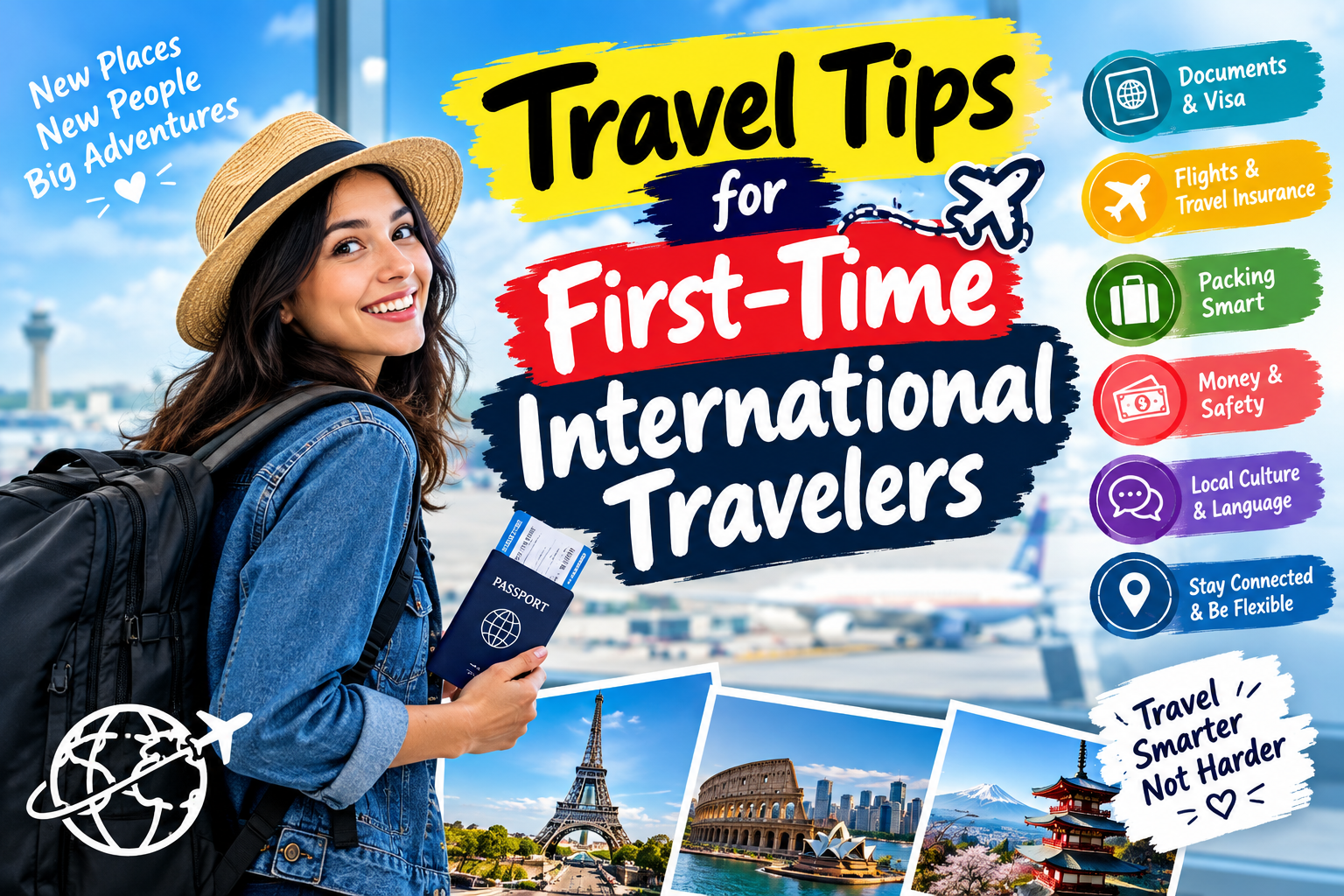
Primary Keyword: travel tips for first-time international travelers
Secondary / LSI Keywords:
- first international trip checklist
- traveling abroad for the first time
- international travel essentials
- passport and visa requirements for beginners
- travel insurance for first-time flyers
- packing tips for international travel
- culture shock tips for travelers
- how to travel abroad safely
Long-Tail Keywords:
- what do I need to know before traveling internationally for the first time
- how much money should I bring on my first international trip
- what should first-time travelers pack for a trip abroad
- is travel insurance necessary for a first international trip
- how do I avoid culture shock when traveling abroad
User Intent: Primarily informational, with a transactional undertone (readers are actively planning a trip and will click through to book flights, insurance, SIM cards, or gear).
Recommended H1: 35 Travel Tips for First-Time International Travelers (From Someone Who’s Made Every Mistake in the Book)
Recommended H2s (with H3 subtopics):
- What “Traveling Internationally” Actually Involves
- Documents vs. Logistics vs. Mindset
- How This Differs From Domestic Travel
- Why Preparation Matters More Than You Think
- The Real Cost of Under-Preparing
- What the Data Says About First-Time Traveler Mistakes
- How to Prepare for Your First International Trip: Step-by-Step
- Documents and Entry Requirements
- Money, Cards, and Currency
- Packing and Health Prep
- Common Mistakes First-Time International Travelers Make
- Money and Documentation Errors
- Cultural and Logistical Missteps
- Expert Tips and Advanced Strategies
- Airport and Flight Tactics
- On-the-Ground Survival Skills
- Who This Advice Is For (and Who Can Skip Some of It)
35 Travel Tips for First-Time International Travelers (From Someone Who’s Made Every Mistake in the Book)
I still remember standing in a currency exchange booth in Lisbon at 11 p.m., jet-lagged and slightly panicked, because I’d assumed my debit card would just “work” everywhere and hadn’t told my bank I was leaving the country. It didn’t work. I had 40 euros in cash and a hostel reservation I couldn’t confirm without a deposit. That single phone call I forgot to make cost me an entire evening and a fair amount of dignity.
If you’re planning your first trip outside your home country, you don’t need to learn that lesson the hard way. These travel tips for first-time international travelers come from years of trial, error, and a slowly-earned checklist that I now run through before every trip — no exceptions. This isn’t generic “bring a passport” advice. It’s the stuff that actually trips people up.
What “Traveling Internationally” Actually Involves
Domestic travel and international travel look similar on the surface — you pack a bag, you get on a plane, you show up somewhere new. But underneath, they’re governed by completely different rulebooks, and most first-time travelers don’t realize how many of those rules only reveal themselves once something goes wrong.
Documents vs. Logistics vs. Mindset
I like to break international travel prep into three buckets, because trying to think about everything at once is how things get missed:
- Documents: passport, visas, entry requirements, vaccination proof, travel insurance
- Logistics: money access, phone/data, transportation, accommodation, packing
- Mindset: cultural norms, language basics, safety awareness, flexibility
Most guides only cover the first bucket. The truth is, the second and third buckets are where most of the actual stress happens on the ground.
How This Differs From Domestic Travel
At home, if your card gets declined, you call your bank and it’s resolved in ten minutes. Abroad, time zones, language barriers, and international call fees turn that ten-minute fix into a half-day ordeal. At home, if you get sick, you know exactly which pharmacy to walk into. Abroad, you might not even know the word for “fever.” None of this is meant to scare you — it’s meant to explain why a little extra prep goes a long way.
Why Preparation Matters More Than You Think
The Real Cost of Under-Preparing
Under-preparing for international travel rarely ruins a trip outright — it just quietly taxes it. A forgotten visa requirement can mean being turned away at check-in. A card that isn’t set up for foreign transactions can mean a stressful scramble for cash. A missed vaccination requirement can mean being denied entry at the border, even with a valid ticket and hotel booking.
In my experience, it’s almost never the big, dramatic disasters that ruin a first international trip — it’s the small oversights that snowball. A missed SIM card purchase turns into an inability to use maps, which turns into a missed train, which turns into a missed check-in window.
What the Data Says About First-Time Traveler Mistakes
Travel insurance providers and consumer travel surveys consistently point to the same handful of issues tripping up new international travelers: not notifying their bank of travel, underestimating visa processing times, packing prohibited items in carry-on luggage, and skipping travel insurance because they assume “nothing will happen to me.” Every one of these is preventable with about thirty minutes of prep — which is exactly why they’re so frustrating when they do happen.
How to Prepare for Your First International Trip: Step-by-Step
This is the section I wish someone had handed me before my first trip. Treat it like a checklist, not a suggestion list.
Documents and Entry Requirements
- Check your passport’s expiration date now. Many countries require your passport to be valid for at least six months beyond your travel dates. If it’s close, renew it immediately — processing times fluctuate and rush fees add up fast.
- Confirm visa requirements for your specific nationality. Visa rules aren’t universal; they depend entirely on the passport you hold. Check your destination country’s official government or embassy website, not a random blog.
- Look into entry requirements beyond visas — some countries require proof of onward travel, proof of funds, or specific vaccinations (yellow fever certificates are a common one for parts of South America and Africa).
- Make physical and digital copies of every document. Photograph your passport, ID, insurance policy, and hotel confirmations, then email them to yourself and store them in an offline folder on your phone.
- Register your trip with your government’s travel advisory program, if one exists. It’s free, and it means someone can reach you in an emergency.
Money, Cards, and Currency
- Call your bank and credit card companies before you leave. Tell them your travel dates and destinations so your first purchase abroad doesn’t trigger a fraud freeze.
- Bring at least two payment methods from different banks. If one card gets flagged, lost, or eaten by an ATM, you have a backup.
- Get a small amount of local currency before you land, just enough for a taxi or a meal. Airport exchange rates are almost always the worst available, so don’t convert more than you need there.
- Understand your card’s foreign transaction fees. A card with no foreign transaction fee will save you a meaningful amount of money over the course of a longer trip.
- Set a rough daily budget based on your destination’s cost of living, and build in a 15–20% buffer for the unexpected.
Packing and Health Prep
- Check your destination’s plug type and voltage. A universal adapter is one of the cheapest, most useful things you’ll pack.
- Pack a basic health kit: any prescription medications (in original packaging, with a copy of the prescription), pain relievers, motion sickness tablets, and any personal essentials that might be hard to find abroad.
- Check whether you need any vaccinations or malaria prophylaxis for your destination — ideally 4–6 weeks before departure, since some vaccines need time to become effective.
- Pack less than you think you need. Almost every first-time traveler overpacks. You can buy toiletries and basic clothing almost anywhere in the world.
- Buy travel insurance that covers medical evacuation, not just trip cancellation. This is the one purchase people regret skipping far more often than they regret making.
[Internal Link: “related article about choosing the right travel insurance policy”]
Common Mistakes First-Time International Travelers Make
I’ve made a good number of these myself, and I’ve watched friends make the rest. Here’s what to avoid.
Money and Documentation Errors
- Not telling the bank you’re traveling. This is the single most common mistake I see, and it’s the one that started this whole article.
- Carrying all your cash and cards in one place. Split your money between your wallet, a separate bag, and a hidden pouch. If one gets lost or stolen, you’re not stranded.
- Assuming your home driver’s license is valid abroad. Many countries require an International Driving Permit alongside your license if you plan to rent a car.
- Underestimating visa processing time. Some visas take weeks, not days. Apply the moment you book your flights, not the week before.
Cultural and Logistical Missteps
- Not learning a handful of local phrases. You don’t need fluency — “hello,” “thank you,” “excuse me,” and “how much does this cost?” go a long way toward smoother interactions.
- Ignoring local customs around tipping, dress, or dining etiquette. What’s normal at home can be genuinely offensive elsewhere. A quick search before you go prevents awkward moments.
- Overpacking your itinerary. First-time travelers often try to see too much in too little time, which leaves no room for the unexpected delays that are basically guaranteed when traveling internationally.
- Skipping data/SIM setup until arrival. Landing without a working data plan in an unfamiliar airport, unable to call a taxi or pull up a map, is a stress you can eliminate in five minutes online before you fly.
Expert Tips and Advanced Strategies
Once you’ve got the basics down, these are the tips that separate a smooth trip from a stressful one.
Airport and Flight Tactics
- Arrive at international airports at least three hours before departure, not the two hours you might be used to domestically. Immigration lines, customs, and security can eat time fast.
- Screenshot your boarding pass and hotel address in the local language, in case your phone loses signal or battery.
- Keep your passport and boarding documents in the same spot every single time. Consistency prevents the “wait, where did I put that” panic at the gate.
- Book a layover of at least 90 minutes for international connections — anything shorter is asking for trouble if your first flight is delayed even slightly.
On-the-Ground Survival Skills
- Download offline maps of your destination city before you land, in case data is unreliable.
- Locate your embassy or consulate’s address and phone number as soon as you arrive — hopefully you never need it, but it takes thirty seconds to save.
- Trust your instincts over your itinerary. If a situation feels off, it’s fine to change plans, skip an activity, or leave somewhere earlier than planned. In my experience, no missed landmark is worth ignoring a bad gut feeling.
Comparison Table: How to Access Money Abroad
| Feature | Debit Card (No-Fee) | Standard Credit Card | Cash / Currency Exchange | Prepaid Travel Card |
|---|---|---|---|---|
| Foreign transaction fees | Usually none | Often 1–3% | None, but poor exchange rates | Varies, often low |
| ATM access | Wide, but ATM fees possible | Cash advances are expensive | N/A | Wide, ATM fees possible |
| Fraud protection | Good | Excellent | None if lost/stolen | Moderate |
| Best for | Everyday spending abroad | Big purchases, points/rewards | Small vendors, tips, emergencies | Budget travelers, teens |
| Setup difficulty | Easy, apply before trip | Easy, apply before trip | None needed | Moderate, load funds in advance |
| Overall recommendation | Best all-around option | Great backup for big spends | Keep some on hand, always | Good for strict budgeting |
Real Results: A First-Trip Case Study
A friend of mine took her first international trip last year — two weeks across Portugal and Spain — after working through a version of this exact checklist. Before the trip, she called her bank, bought a local SIM online in advance, split her cash across three locations, and got a no-foreign-fee debit card two weeks before departure.
The result: no card declines, no data gaps, and the only real hiccup was a 40-minute train delay that she’d already built buffer time around. Compare that to her sister’s first international trip years earlier, which involved a frozen debit card, three hours lost trying to find a working ATM, and a missed bus connection as a direct result. Same destination, same budget range — the difference was entirely in the prep.
Who Should Use This Advice (and Who Can Skip Some of It)
This guide is built for genuine first-timers — people who’ve never left their home country or have only done a handful of short, low-friction trips (think Canada-to-U.S. or intra-EU travel with familiar currency and language).
If you’re already an experienced traveler, most of this will feel like common sense, and you can safely skip straight to destination-specific research. But if this is your first time crossing an ocean, dealing with a new currency, or navigating a language you don’t speak, treat the documents and money sections as non-negotiable — they’re the two areas most likely to derail an otherwise well-planned trip.
Conclusion
Your first international trip doesn’t need to be perfect — it just needs to avoid the handful of preventable mistakes that trip up most beginners: unnotified banks, missed visa windows, overpacked bags, and skipped travel insurance. Handle the documents, sort your money access, pack light, and give yourself buffer time at every transition point. The rest — the parts that actually make travel unforgettable — you’ll figure out just fine once you land. Start your checklist today, and you’ll thank yourself the moment you step off that first international flight.
FAQ Section
1. What documents do I need for my first international trip? At minimum, you’ll need a valid passport (often required to have six-plus months of validity remaining), any required visa for your destination, and proof of onward travel or accommodation in some cases. Depending on where you’re going, you may also need proof of vaccination. Always verify requirements on your destination’s official embassy or government website rather than relying on general travel blogs, since rules vary by nationality.
2. How much cash should I bring on my first trip abroad? In my experience, bringing a small amount of local currency — enough to cover a taxi, a meal, and small purchases for the first day — is plenty. Beyond that, rely on a no-foreign-fee debit or credit card for most spending, and keep a modest emergency cash reserve split across different bags or pockets in case a card is lost or declined.
3. Do I really need travel insurance for my first international trip? Yes, and this is one of the few things I’d call non-negotiable. Medical care abroad, especially in countries with no reciprocal healthcare agreements with your home country, can be extremely expensive. A policy that covers medical evacuation and emergency treatment is worth far more than its cost the one time you actually need it.
4. How do I avoid culture shock as a first-time traveler? Culture shock is rarely avoided entirely, but it can be softened. Research basic etiquette, tipping norms, and dress expectations before you go, learn a handful of local phrases, and go in expecting things to be different rather than expecting them to match home. Give yourself permission to feel disoriented for the first day or two — it’s normal and it passes quickly.
5. Should I notify my bank before traveling internationally? Yes, always. Many banks flag or freeze cards when they detect sudden foreign transactions, assuming it’s fraud. A two-minute call or an in-app notification before you leave prevents an avoidable headache at exactly the wrong moment.
6. How early should I apply for a visa? As early as possible — ideally the moment you’ve booked your flights. Processing times vary widely by country and can range from a few days to several weeks, and rush processing (when available) usually comes with extra fees.
7. What’s the biggest mistake first-time international travelers make? Based on what I’ve seen repeatedly, it’s underestimating the small logistical details — bank notifications, SIM cards, plug adapters — rather than the big obvious ones like booking flights or hotels. Those small oversights are what actually cause stress on the ground.
8. Do I need an International Driving Permit? If you plan to drive at your destination, check in advance — many countries require an International Driving Permit alongside your home license, and rental agencies may refuse a car without one. This is one of the more commonly overlooked requirements for first-time travelers.
9. How much luggage should a first-time international traveler pack? Less than you think. Almost everyone overpacks on their first trip. A single checked bag or even just a carry-on is usually enough for a two-to-three week trip, and most toiletries or clothing basics can be bought at your destination if needed.
10. What should I do if I lose my passport abroad? Contact your country’s nearest embassy or consulate immediately — this is why saving that contact information as soon as you land matters. Most embassies can issue an emergency travel document, though it may take a day or more, so file a police report as well if required for the replacement process.
Meta Description: Planning your first trip abroad? These travel tips for first-time international travelers cover documents, money, packing, and mistakes to avoid.